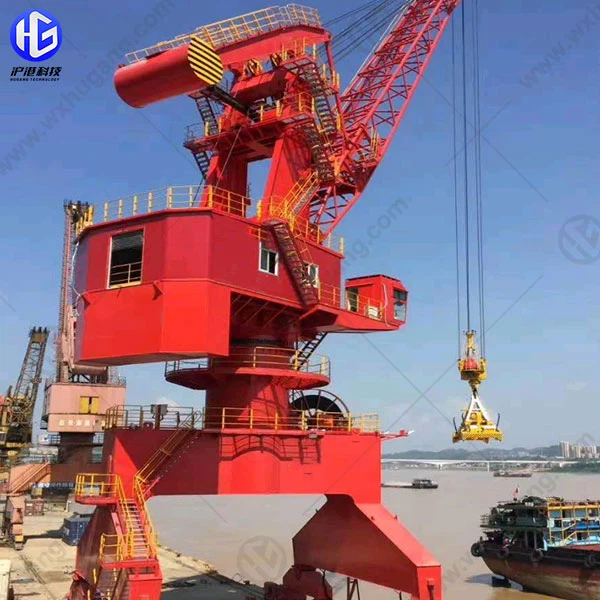
If you've ever stood at the edge of a busy harbor, watching massive cargo containers move seamlessly between ships and shore, chances are you've spotted a Harbour Portal Crane in action. These cranes are the workhorses of port operations, capable of lifting tens of tons at a time, navigating tight quay spaces, and operating in harsh coastal conditions. But for all their power and precision, their ability to keep cargo moving safely depends almost entirely on a suite of purpose-built safety devices. As a supplier of these critical machines, I've spent years working with port operators to refine these safety features, knowing that even a single failure can lead to costly delays, dangerous accidents, or lost revenue.
First, let's ground this in what makes Harbour Portal Cranes unique, because their design dictates the safety tools they need. Unlike mobile cranes that travel on rubber tires, Harbour Portal Cranes are fixed to a steel portal that runs along rails on the quay, giving them stability for heavy lifts but also making them susceptible to forces like wind, ship movement, and shifting load weight. They come in different configurations too: Level-Luffing Portal Crane models adjust their jib height to keep the load at a consistent horizontal level (critical for avoiding collisions with ship structures), Single Jib Portal Crane designs are compact for smaller quays, and Rack-Luffing Portal Crane options use a gear and rack system to move the jib for heavier lifts. No matter the type, all share a core set of safety devices that are non-negotiable for reliable port operation.
One of the most fundamental safety components is the Overload Protection System (OLS), and it's the first line of defense against catastrophic crane failure. When a Harbour Portal Crane lifts a load, the OLS uses load cells mounted in the hoist ropes or hooks to measure the exact weight being lifted. If the load exceeds the crane's rated capacity-say, a 50-ton crane trying to lift 55 tons-the OLS triggers a series of alarms: a visual alert on the operator's console, a loud audio warning, and it automatically cuts off power to the hoist's upward movement. What many operators don't realize is that modern OLS systems also account for dynamic loads, like the swing of a container mid-lift or the jerk from a starting ship. Years ago, we had a client who tried to compensate for a heavy load by extending the jib further out, only to trigger the OLS mid-lift. Now, all our Port Portal Crane models integrate OLS with jib length sensors, so it calculates load capacity based on both weight and boom radius, eliminating that old risk.
Next up is the Anti-Collision System, a must-have for busy harbors where multiple cranes operate in close proximity. A Harbour Portal Crane sits on rails, often just a few meters away from adjacent cranes, ships, and quay structures. Without this system, a miscalculated swing could lead to a collision that damages millions of dollars' worth of equipment. Our Anti-Collision System uses a combination of GPS, ultrasonic sensors, and radar to monitor the position of nearby cranes, ships, and fixed obstacles in real time. The operator's console displays a 3D map of the surrounding area, showing distance to other objects, and if the crane gets too close, it sends a gradual alert first, slowing movement before triggering a hard stop. We even add a separate anti-slew function specifically for the crane's rotating superstructure, because a swinging jib can reach much further than the portal itself. Last year, a port in Singapore avoided a near-disaster when their new crane's Anti-Collision System detected a nearby vessel shifting positions mid-lift, and automatically adjusted the crane's swing to avoid impact.
Wind is one of the biggest threats to Harbour Portal Cranes, especially in coastal areas where gusts can spike without warning. A crane that's stationary or lifting a load during a strong wind can tip over, a disaster that not only destroys the crane but also blocks the entire quay. That's why we install a Wind Speed Monitoring and Protection System (WSMS) on every crane we supply. The system uses anemometers mounted at the top of the crane's jib to measure wind speed and direction continuously. If wind speeds exceed the crane's operational limit-typically around 40 knots, depending on the model-the WSMS sends an alert to the operator, warning them to lower any loads to the ground and stop all lifting operations. If winds reach the crane's threshold for stationary operation (usually around 60 knots), the system automatically engages the crane's rail clamps, locks the jib in a low-drag position (called "jib stow"), and even turns the superstructure to face the wind, reducing its surface area. We once retrofitted an older Level-Luffing Portal Crane that kept being shut down unexpectedly by wind alarms; after calibrating the WSMS to account for the local harbor's wind patterns, the number of unnecessary stops dropped by 70%, keeping operations on track while still maintaining safety.
Load sway is another constant challenge for port cranes, especially when lifting containers from a moving ship. A swinging load can hit the ship's deck, nearby cranes, or even personnel, causing damage or injury. That's why our Harbour Portal Cranes are equipped with Load Sway Control Systems, which use accelerometers on the hook block to detect load movement. The system then sends real-time signals to the crane's hydraulic or electric drives, adjusting the speed and direction of the hoist, trolley, and jib to counteract the sway. For operators, this means they can focus on positioning the load accurately instead of fighting to steady it, and it reduces the risk of costly container damage from collisions. Some smaller cranes we supply for regional ports use a simpler pendulum dampening system, but for larger Port Portal Crane models, we integrate automated sway damping that works even during ship movement, which is a game-changer for overnight operations on a tidal berth.
Beyond these operational safety features, there are several passive safety devices that work behind the scenes every time the crane is in use. One critical passive component is the Rail Brake System, which keeps the crane from sliding off its rails, especially when parked or in high wind. We supply two types of rail brakes: spring-applied, hydraulically released brakes that engage automatically if power is lost, and adjustable clamps that can be tightened along the entire length of the crane's portal to distribute force evenly. There are also Limit Switches for every moving part of the crane: hoist limit switches that prevent the hook from over-lifting and crashing into the jib head, trolley limit switches that stop the trolley from running off the end of the quay, and jib luffing limit switches for Level-Luffing and Rack-Luffing Portal Crane models that stop the jib from luffing beyond its safe height. These switches are mechanical as well as electronic, so even if the electrical system fails, they rely on physical contact to trigger a stop-an essential backup for high-risk environments.
Another often-overlooked safety feature is the Operator Cabin Safety System. The cabin, perched at the end of the jib or on the crane's superstructure, is the operator's command center, so it needs to protect them as well as keep them connected. All our cabins are equipped with shock-absorbing mounts to reduce vibration during long shifts, ergonomic controls to prevent operator fatigue, and a dedicated emergency stop button within arm's reach of the operator at all times. We also install CCTV cameras that feed multiple views to the cabin screen, including a close-up of the hook block, a wide view of the quay, and a view of the surrounding cranes, so the operator never has to guess what's around their load. For ports with 24/7 operations, we add thermal imaging cameras to help the operator see in low light or fog, reducing the risk of collisions when visibility is poor.
Fire safety is a must for heavy industrial equipment that runs on high-voltage electricity and hydraulic fluids. Every Harbour Portal Crane we supply has a dedicated fire detection and suppression system. The system includes smoke detectors mounted in the electrical control cabinets and hydraulic pump rooms, which trigger an alarm as soon as smoke is detected, and a CO2 fire suppression system that can be activated remotely or automatically to starve a fire of oxygen without damaging sensitive electrical components. We also train our clients to inspect the system regularly, because hydraulic leaks are a common ignition source if not addressed. A port in South Africa once had a minor hydraulic leak in one of their older cranes; the fire detection system caught it before it ignited, and the suppression system put out the small fire before it spread to the rest of the crane, saving them hundreds of thousands in replacement costs.
I've been working with port cranes for over 15 years, and the one thing that sticks with me is that safety isn't just a list of devices-it's a mindset that we build into every crane we design. When we first started, some operators saw safety features as a nuisance, like alarm systems going off for no reason or functions being limited by technology. But over time, as we've refined these devices and proven that they don't just prevent accidents but actually improve productivity-reducing delays, cutting down on load damage, and extending crane lifespan-operators now see them as essential tools, not add-ons. Whether you're a small regional port investing in a Single Jib Portal Crane for new container services or a major global harbor upgrading a fleet of Port Portal Crane models, the safety devices that come with your crane will make or break your operations.
If you're looking to upgrade your existing crane fleet or purchase a new Harbour Portal Crane tailored to your port's needs, our team can walk you through every safety feature, adjust systems to match your local conditions, and provide ongoing support to keep your cranes running safely. We understand that every port has unique challenges-tidal variations, wind patterns, quay space constraints-and we don't believe in one-size-fits-all solutions. To learn more about how we can help, reach out to our team for a consultation.